Hostinger
Best for: New sitesPros
- Low entry price
- Beginner friendly
Cons
- Higher renewal rates
Cloudways
Best for: Developers and agenciesPros
- Monthly, no contract
- Choose cloud provider
Cons
- More knobs to manage
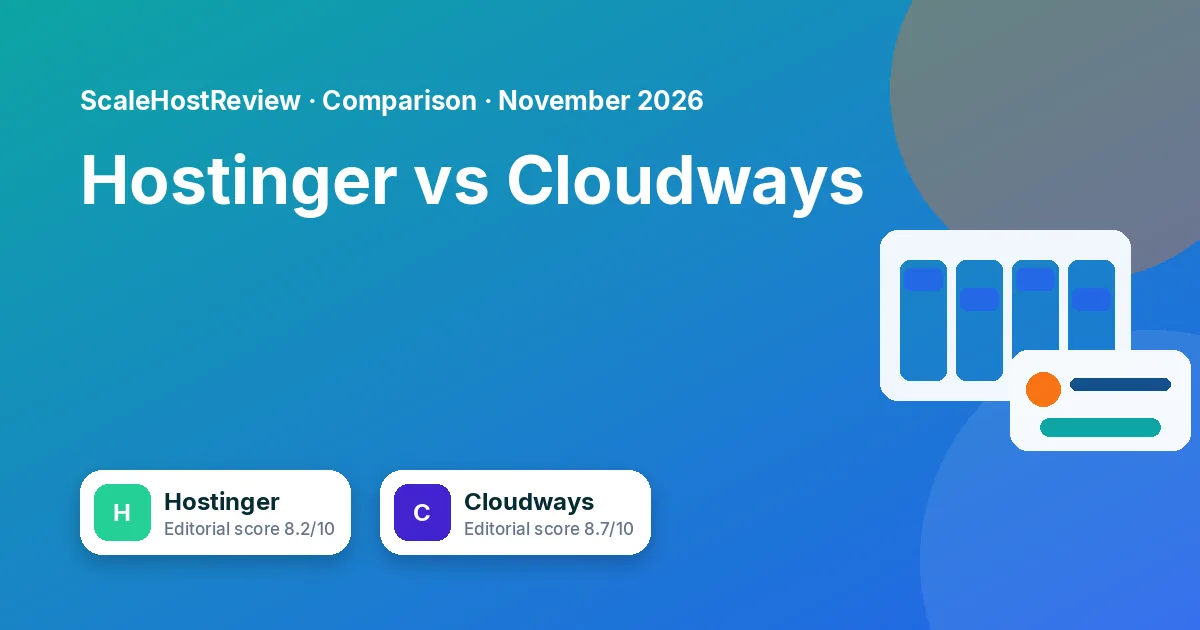
Hostinger is where many sites start. Cloudways is where many go once traffic and revenue grow. The question is when the upgrade pays for itself.
Signs you've outgrown budget hosting
- Pages slow down noticeably during traffic spikes.
- You need staging to test changes safely.
- Your site makes enough money that an hour offline costs more than a month of better hosting.
| Hostinger | Cloudways | |
|---|---|---|
| Price level | Budget (watch renewal rates) | Mid-range, monthly billing |
| Resources | Shared | Dedicated server resources per plan |
| Skill needed | Beginner | Comfortable beginner to developer |
Plans and prices change. Check current pricing on the official page: www.hostinger.com/pricing.
Plans and prices change. Check current pricing on the official page: www.cloudways.com/en/pricing.php.
See Hostinger →Official site, not an affiliate link
See Cloudways →Affiliate link
How this page was made: from each provider's official product and pricing pages and its public documentation, read on the date named in the page. We have not run a hands-on test, lab benchmark, or paid user study for this page. A step-by-step section describes the vendor's published flow. It is not a test we performed.
WP Engine, Cloudways, Liquid Web, Hostinger and DigitalOcean change prices and promotions often, and introductory rates can differ from renewal rates. We link to each official pricing page instead of listing figures: WP Engine, Cloudways, Liquid Web, Hostinger, DigitalOcean.
See also managed vs shared hosting.

How we evaluated
Scores on this page are editorial scores out of 10. They are a judgment from the provider's product, pricing and documentation pages, using the weights below. They are not user ratings, lab results, or a ranking anyone paid for. A price is only as current as the date written next to it. The research methodology covers what we do not do.
| Criterion | Weight | What we looked at |
|---|---|---|
| Managed features | 30% | Staging, backups, caching, CDN, security, migrations |
| Plan limits and pricing | 25% | Visit and storage limits, renewal and overage pricing |
| Infrastructure and scaling | 20% | Cloud provider, data centers, scaling options |
| Support | 15% | Documented channels and hours |
| Business and agency fit | 10% | Multi-site plans, team access, white-label options |
When to move from Hostinger to Cloudways
Signs you've outgrown entry-level hosting include slow admin pages, resource limit warnings, traffic spikes causing errors, or running several sites that need isolation. At that point Cloudways' dedicated cloud resources make sense. For a first site, Hostinger keeps costs low.
Walkthrough: launching a first site on each
Hostinger
Pick a plan, register or connect a domain, use the setup wizard to install WordPress, choose a theme, and publish. The control panel handles SSL, backups and email on included plans. It's built for people doing this for the first time.
Cloudways
Choose a cloud infrastructure provider and server size, launch the server, add a WordPress application, point your domain and enable SSL. The dashboard exposes more controls, such as server settings, caching layers and application isolation. It's built for people who want control without managing a raw server.
Buying criteria
- Budget: Hostinger's entry pricing is lower; check renewals.
- Billing: Cloudways bills monthly for server resources; Hostinger's best prices usually need longer terms.
- Number of sites: Cloudways can host many sites per server.
- Email: Hostinger includes email on many plans; Cloudways typically relies on add-ons or separate email services.
- Skill level: Hostinger is friendlier; Cloudways rewards some technical comfort.
Backups: what to check
- Frequency: daily automatic backups are standard on managed plans; busy stores may want more frequent ones.
- Retention: how many days of backups are kept.
- Restore process: one-click restore, and whether you can restore only files or only the database.
- Off-site copies: whether backups are stored separately from the server.
- Downloadable backups: keep your own copy periodically, so you aren't dependent on a single provider.
- Test a restore to staging at least once, so you know it works before an emergency.
Domains, DNS and email
Your domain registrar, DNS host, web host and email provider can all be different companies. Many managed WordPress hosts don't include email hosting, so you'd use a separate business email service. Before moving, list every DNS record you rely on (website, email MX, SPF, DKIM, verification records) and recreate them carefully if you change DNS providers. Mistakes here break email more often than websites.
Hosting glossary
- Managed WordPress hosting
- Hosting where the provider handles WordPress-specific performance, security and updates.
- Shared hosting
- Many sites share one server's resources.
- VPS
- A virtual private server with dedicated resources.
- CDN
- A network that serves files from locations close to visitors.
- PHP workers
- Processes that handle uncached requests at the same time.
- TTL
- How long DNS records are cached.
What actually makes WordPress fast
Hosting matters, but it's one of several layers. Server-level caching serves pages without running PHP for every visitor. A content delivery network serves static files from locations near the visitor. Current PHP versions run WordPress code faster than old ones. Object caching helps logged-in and dynamic pages, such as carts. Beyond hosting, image size, the number of plugins, heavy page builders and third-party scripts often matter more than the server. Before blaming a host, run a performance test, check what takes the longest to load, and fix oversized images and unused plugins first. Then compare hosts using the same site copy, measured the same way, on the same day.
How to migrate a WordPress site with minimal downtime
- Back up everything on the old host: files, database and email if it's hosted there too.
- Check the new host's migration options. Many managed hosts offer free migrations or a migration plugin. Read the terms for how many sites are included.
- Copy the site to the new host and test it on a temporary URL or by editing your local hosts file.
- Lower your DNS TTL a day ahead so the switch propagates faster.
- Freeze content changes briefly, especially for stores, so no orders are lost between copies.
- Point DNS to the new host, then issue or verify the SSL certificate.
- Test critical paths: home page, forms, checkout, logins and search.
- Keep the old host active for a week or two before cancelling, in case you need to roll back.
Planning for traffic spikes
If you expect a launch, sale or press mention, prepare ahead. Confirm what your plan does when traffic exceeds normal levels: some hosts absorb spikes, some throttle, and some bill overages. Make sure pages are cached, the CDN is on, and heavy plugins are disabled on landing pages. Ask support whether they recommend a temporary upgrade, and monitor the site during the event.
Using staging environments safely
A staging site is a copy of your live site where you can test updates, new plugins or design changes without affecting visitors. Most managed WordPress hosts provide one-click staging. A safe routine: create or refresh staging from live, apply the update, click through key pages and forms, then push to live during a quiet period. Be careful pushing databases from staging to live on stores or membership sites, since you could overwrite orders or new users created in the meantime. Push files only, or use selective push options where your host provides them.
Security responsibilities: host versus you
Managed hosts typically handle server patching, firewalls, malware scanning and, on many plans, malware cleanup. They often block known bad traffic and provide free SSL certificates. You remain responsible for strong admin passwords and two-factor authentication, updating plugins and themes, removing abandoned plugins, limiting admin accounts, and choosing reputable extensions. Read each host's security page for what is included, especially whether hack cleanup is free and whether a web application firewall is part of the plan or an add-on.
Keeping PHP and WordPress current
WordPress runs on PHP, and newer supported PHP versions bring security fixes and better performance. Most managed hosts let you switch PHP versions per site from the dashboard. Upgrade on staging first, check for plugin or theme errors, then switch live. Keep WordPress core, themes and plugins updated on a regular schedule, and turn on automatic minor updates if your host supports them. Old PHP versions eventually stop receiving security patches, so plan upgrades rather than waiting for a forced change.
Monitoring after launch
Set up an external uptime monitor that checks your site every few minutes and alerts you by email or text. Watch your host's resource or visits dashboard monthly. Track Core Web Vitals in search console over time rather than relying on one speed test. When something slows down, check recent plugin updates first, then traffic changes, then contact support with specific timestamps.
Extra considerations for WooCommerce stores
Stores are more demanding than brochure sites because carts, checkouts and account pages can't be fully page-cached. Look for hosts with object caching, enough PHP workers for concurrent shoppers, and caching rules that exclude cart and checkout pages. Schedule updates during low-traffic periods, test checkout on staging after every plugin update, and keep frequent backups. If you run sales events, ask your host how it handles traffic spikes.
Understanding visit-based limits
Several managed WordPress hosts price plans by monthly visits rather than raw server resources. Each host defines a "visit" its own way, often counting unique IP addresses over a period, and bots may or may not be excluded. If you exceed the limit, hosts may charge overage fees or ask you to upgrade. To estimate: look at your analytics for monthly users, add a buffer for traffic spikes and bots, and read the host's definition and overage terms on its official pricing page.
Pre-launch checklist on a new host
- SSL certificate active and HTTP redirects to HTTPS.
- Caching configured with exclusions for dynamic pages.
- Daily backups confirmed and one restore tested.
- Staging environment created.
- Uptime monitoring set up with alerts.
- Admin accounts reviewed and two-factor authentication on.
- Contact forms and transactional emails tested.
- Search console and analytics verified.
Images: the cheapest speed win
Large images are often the heaviest part of a page. Resize images to the largest size they actually display at, serve modern formats such as WebP where supported, and lazy-load images below the fold. WordPress generates several sizes automatically; make sure themes use appropriate ones. Some hosts and CDNs offer automatic image optimisation, sometimes as an add-on. Fixing images usually improves load times more than switching hosting plans.
Plugin hygiene on any host
Plugins cause more WordPress slowdowns and security problems than hosting does. Review your plugin list every few months: remove anything inactive, replace plugins that haven't been updated in a long time, and avoid installing several plugins that do the same job, such as two caching or two security plugins. On managed hosts, skip caching plugins that conflict with server-level caching unless the host recommends one. Before installing anything new, check its update history, support activity and compatibility with your WordPress and PHP versions, and test it on staging first.
Testing support before you commit
WordPress support quality varies more than features do. During a trial or before buying, open a chat with a realistic technical question, such as how to configure caching exclusions for a cart page, or how to set up a staging push without overwriting orders. Note how long a response takes, whether the person understands WordPress specifically, and whether they give steps or links to documentation. Check whether phone support is available or only chat and tickets, and whether higher plans get priority.
Frequently asked questions
Why does Hostinger renew higher?
Can I start on Hostinger and migrate later?
Does Cloudways include email hosting?
Which is better for a blog?
How we score
Our scores are editorial scores out of 10. They are a judgment across the criteria below, using each provider's own pages. They are not user ratings, hands-on test results, or a placement anyone paid for. A commission on an approved affiliate link does not change a score. Full research methodology.
- Managed features (staging, backups, caching, CDN)
- Plan limits and renewal/overage pricing
- Infrastructure and scaling options
- Support channels documented
- Fit for business and agency use